






Q355B and S355JR/J0 are functionally equivalent grades for general construction, but they originate from different standard systems (Chinese GB vs. European EN) and have nuanced differences.
1. Standard Basis: Q355B is defined in GB/T 1591-2018. S355JR and S355J0 are defined in EN 10025-2:2019.
2. Yield Strength Definition: Both define minimum yield strength (ReH) based on thickness. The values are nearly identical. For example, for t <= 16mm, both are 355 MPa. The derating tables for thicker products are very similar.
3. Impact Toughness: This is a key differentiator. S355JR requires 27J at +20℃. S355J0 requires 27J at 0℃. Q355B requires 34J at +20℃. Therefore, Q355B has a higher impact energy requirement at the same temperature than S355JR and specifies room temperature testing versus the lower temperature for J0. The "J0" grade is more directly comparable in terms of intended service temperature (colder).
4. Chemical Composition: The limits are broadly similar but not identical. EN 10025-2 often has slightly different limits for elements like Carbon, Manganese, and particularly for Phosphorus and Sulfur. For example, for S355J0, P<=0.030%, S<=0.025%, while for Q355B, both are <=0.030%. The CEV calculation and limits may also differ slightly.
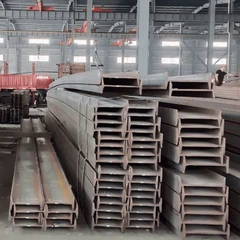
5. Product Standards: I-beam dimensions differ. European parallel flange beams are designated as HEA, HEB, HEM (per EN 10365), with different dimension series than the Chinese HW, HM, HN series in GB/T 706.
6. Marking and Certification: EN standards require specific marking (e.g., grade, manufacturer, standard) and the CE marking for the EU market. In practice, for many international projects, if Q355B is offered as an alternative to S355J2 (27J at -20℃) or S355J0, a technical deviation review is needed, focusing on the impact test temperature and chemical composition limits. Often, Q355B with supplemental Charpy testing at 0℃ or -20℃ can satisfy the requirements for S355J0 or J2.
Table: Comparison of Q355B, S355JR, and S355J0 (Key Parameters for thickness <=16mm)
| Q355B (GB/T 1591) | S355JR (EN 10025-2) | S355J0 (EN 10025-2) | |
|---|---|---|---|
| Min. Yield Strength ReH | 355 MPa | 355 MPa | 355 MPa |
| 470-630 MPa | 470-630 MPa | 470-630 MPa | |
| Impact Test Temp. | +20℃ | +20℃ | 0℃ |
| Min. Impact Energy KV | 34 J | 27 J | 27 J |
| Max. Phosphorus (P) | 0.030% | 0.035% | 0.030% |
| Max. Sulfur (S) | 0.030% | 0.035% | 0.025% |